


The PS5608 pumping library is as an upgrade of the PS571 pumping library (for AC500 V2). Specifically designed for pumping stations equipped with up to eight pumps, this library encompasses a comprehensive set of function blocks. This library helps in configuring and monitoring the various pumps in pumping stations.
Depending on the pumping station requirement and objectives, the available process modes typically include pressure control, flow control, and level control.
-
Pressure control: This mode focuses on maintaining a specific pressure level within the system. It is ideal for applications where pressure regulation is paramount, such as in water supply systems or hydraulic systems.
-
Flow control: Flow control mode is employed to regulate the rate at which the fluid is pumped through the system. It is essential in applications where maintaining a consistent flow rate is critical, such as in chemical manufacturing or irrigation systems.
-
Level control: Level control mode is employed to manage the height or volume of liquid in a reservoir or tank. It is commonly used in wastewater treatment plants, industrial storage tanks, and sewage systems.
Depending on the specific operational needs and desired level of control and efficiency for the pumping stations, it offers various operational modes, each tailored to meet different requirements:
-
Multimode - all VFD pumps: In this mode, all pumps are equipped with Variable Frequency Drives (VFDs). VFDs allow for precise control of pump speed, making it ideal for applications where fine-tuning flow rates and pressure is essential. This mode provides high efficiency and flexibility.
-
Traditional mode - One pump VFD, other DOL pumps: This configuration combines the advantages of a VFD pump with the simplicity of direct-on-line (DOL) pumps. Typically, one pump is equipped with a VFD for precise control, while the others operate using a traditional DOL starter. This mode balances control and cost-effectiveness.
-
DOL Mode - All DOL Pumps: In this mode, all pumps operate using direct-on-line (DOL) starters, which provide basic on/off control without speed variation. It's a cost-effective choice for applications where precise control is less critical.
Basic block diagram of a pumping station is as shown below.
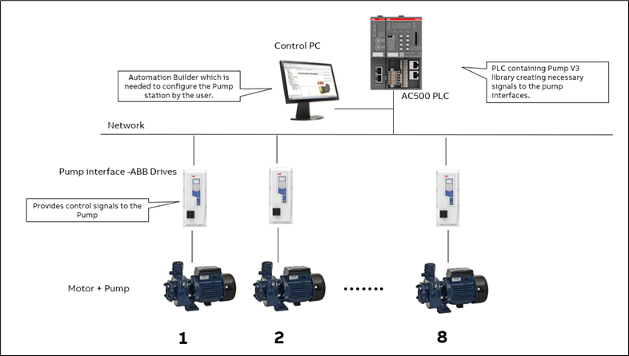
The key features supported by the library includes:
-
Configuration functions for pump station that permits:
-
Users to customize pump parameters like pump station name, number of pumps, process mode of pumps, pump combination and pump speed.
-
Communication with all pumps in the field that are run by DOL/VFD motors by configuring the pump settings and collecting the pump operation status.
-
-
Pumping functions of the pump that supports:
-
Precise management of emptying and filling operations by comparing actual fluid level with the set fluid level for level control.
-
Uniform fluid level distribution across multiple tanks and reservoirs by providing ON/OFF command to the pumps for level control.
-
Maintenance of flow in the network for flow control.
-
Stabilization of pressure in the network for pressure control.
-
Closed loop control of pressure and flow using PID control.
-
Pump turn off/on sequence generation based on demand.
-
-
Auxiliary functions of the pump that include:
-
Cleaning up of the pump using antijam functionality.
-
Capability to calculate and monitor energy consumed and saved.
-
Calculation of pump flow rate using pump head flow and pressure flow rate curve characteristics.
-
Computation of maintenance schedule for the pump.
-
Offering analog and binary protection mechanisms to safeguard pumps against operational risks.
-
Conserving energy by enabling pumps to enter sleep mode during periods of low demand.
-
Soft fill functionality that ensures gradual pump start up to prevent water hammer and system stress.
-
-
Simulation functions of the library that help in system test and validation consists of:
-
DOL (Direct-on-line pumps) simulation
-
VFD (Variable Frequency Drive) simulation
-
Pumptank simulation for tank behavior.
This PLC library for pumping stations is a comprehensive solution that together optimize pump control, energy efficiency, maintenance, protection, and system simulation. It stands as an invaluable tool in the field of industrial automation, ensuring reliability, efficiency, and cost-effectiveness across a wide range of pumping applications.
-