Network addresses represent a mapping of the addresses of the network type (for example IP) to logical addresses within a control network. This mapping is performed by the corresponding block driver. The first three bytes of the IP address are identical for all network devices within an Ethernet network with "Class C" IP addresses. Consequently, the last 8 bits of the IP address suffice as network address, since they enable unambiguous mapping between the two addresses on the block driver.
A node has a different network address for each network connection. Different network connections can have the same network address, since each address need only be locally unique.
Terminology: The network address in the main network is usually designated as the network address of a node with no specification of the network connection.
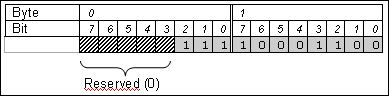
The length of a network address is specified in bits and can be chosen by the block driver as required. The same length must be used for all nodes within a network area. A network address is represented by an array of bytes in accordance with the following coding:
-
Length of the network address: n bits
-
Required bytes: b = (n + 7) DIV 8
-
The (n MOD 8) bits of lowest rank of the first byte and all others (n DIV 8) are used for the network address.
Example of the coding of a network address
Length: 11 bits
Address: 111 1000 1100